

AI visibility monitoring is how brands see their share of AI answers
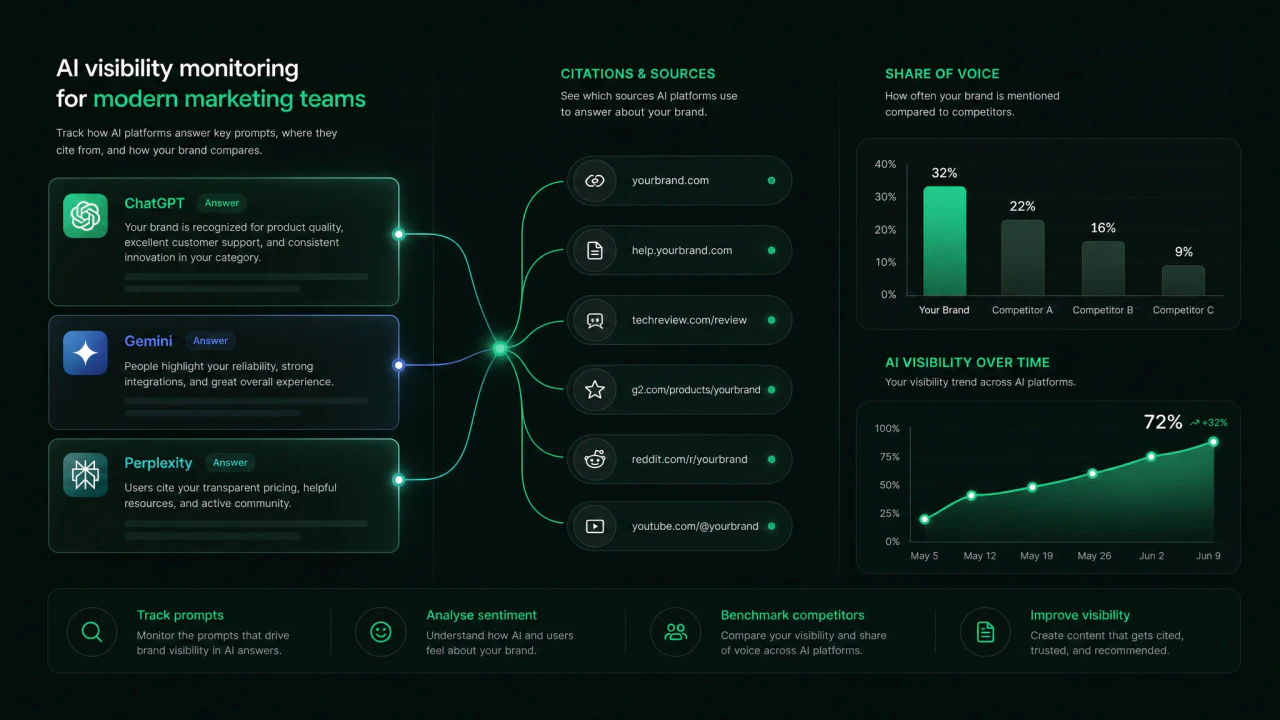
AI visibility monitoring is the process of tracking where, how often, and in what context a brand appears in AI-generated answers, including the sources those answers cite and the competitors they recommend. It turns the problem behind AI Visibility Monitoring: You Can't Optimise What You Can't See into a measurement discipline: if a team cannot see its AI mentions, source coverage, sentiment, and competitive position, it cannot improve them deliberately. Measuring AI search visibility means tracking brand mentions, citations, and share of voice across major AI platforms.
AI visibility monitoring: repeatable measurement of brand presence in answer engines, chat search, and AI-assisted search results.
- See whether your brand appears for priority buyer prompts.
- Understand whether AI systems describe the brand accurately, positively, or weakly.
- Find which pages, reviews, directories, and articles influence cited answers.
- Compare your answer share against competitors, not against a static keyword rank.
- Prioritise content, source, and positioning fixes based on measured gaps.
AI visibility tools track brand appearances in platforms like ChatGPT, Gemini, and Perplexity. For marketing, communications, SEO, and product teams, the value is not just seeing a mention. The value is knowing why that mention happened, what the answer said, which source supported it, and what to change next.
Why AI visibility is now a measurable growth channel
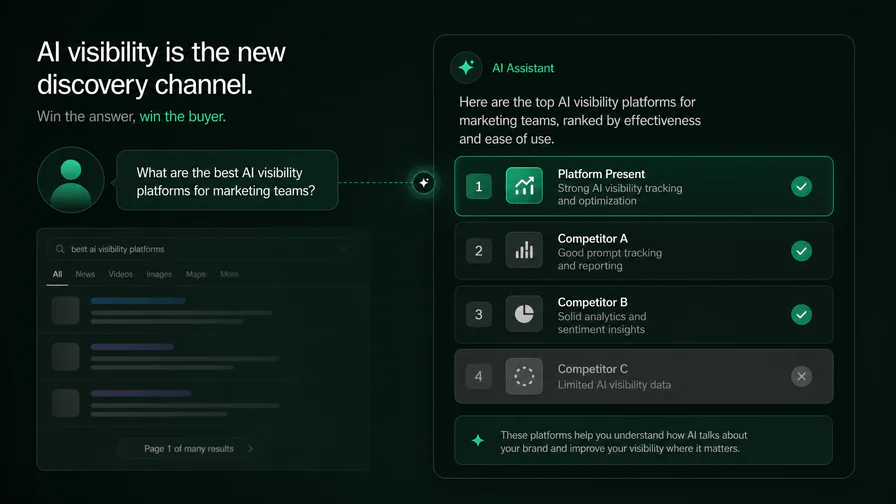
AI answers are now part of the buying path, especially for high-consideration software, services, and B2B categories. Buyers ask AI systems to compare vendors, explain category differences, recommend shortlists, validate pricing claims, and summarise reviews before they ever visit a brand site.
That changes the risk profile. A brand can rank well in classic search and still be absent from an AI-generated shortlist. It can be mentioned, but described with stale messaging. It can be recommended, but only because a third-party page, not its own content, provides the supporting evidence.
Visibility gaps translate into lost demand, weaker positioning, and missed citation opportunities. AI visibility monitoring makes those gaps measurable before they become revenue problems.
What to track in AI answers in 2026
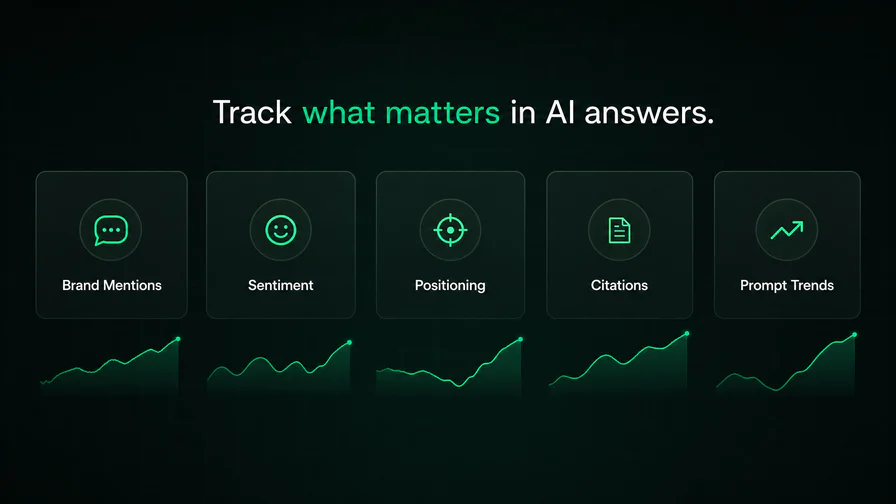
Track the answer, the source, and the pattern over time. A one-off prompt screenshot is not monitoring. A useful framework captures structured evidence across prompts, AI systems, locations, buyer stages, and competitors.
| Dimension | What to measure | Why it matters |
|---|---|---|
| Brand mentions and answer inclusion | Whether the brand appears for priority prompts | Shows raw presence in AI answers |
| Sentiment and accuracy | Positive, neutral, negative, misleading, or outdated framing | Shows whether visibility helps or harms trust |
| Positioning | Whether the brand is recommended first, listed later, or framed behind competitors | Shows competitive strength inside the answer |
| Citations and sources | Which pages, domains, and passages support the answer | Shows what evidence AI systems rely on |
| Prompt, geography, and time | Prompt cluster, market, language, and trend changes | Shows where visibility is stable, rising, or falling |
Prompt coverage should map to real buyer questions, not just keywords. Use prompt tracking to group prompts by category, use case, comparison, objection, and purchase stage.
Mentions, sentiment, and positioning
A positive signal is not only a brand mention. It is an accurate, confident recommendation in a relevant answer. A neutral signal might list the brand without detail. A negative signal might describe the product as expensive, limited, outdated, or unsuitable without current evidence. A missing signal is absence from prompts where the brand has a legitimate claim to appear.
Practical examples:
- Positive: recommended for a named use case with current strengths.
- Neutral: included in a list, but not explained.
- Negative: framed behind competitors on capability or trust.
- Missing: absent from category, comparison, or problem-solution prompts.
Citations, sources, and content gaps
Citations matter as much as the answer because they reveal what the AI system treats as evidence. An answer can mention a brand but cite an old directory page, a competitor comparison, or a third-party article with incomplete information.
Citation tracking connects directly to AEO, GEO, and answer-ready content. If AI systems cite competitor pages for prompts your brand should own, that is a content gap. If they cite your site but pull weak passages, that is a content quality gap. Mentions and sources should show which sources drive mentions, not just whether a mention occurred. Auditing technical foundations and structured data makes sites easier for AI crawlers to understand.
How AI visibility monitoring works
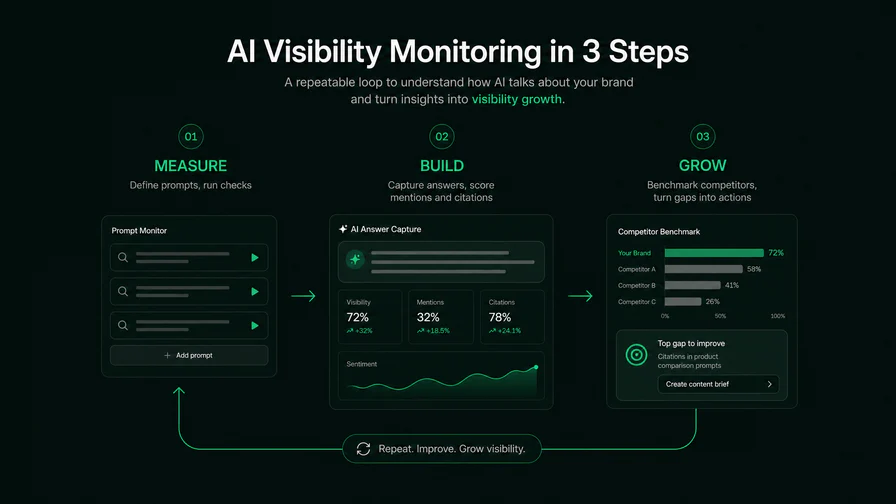
AI visibility monitoring works by turning prompts into repeatable tests and answer outputs into scored records. The process is practical:
- MEASURE: Define priority prompts across category, use case, comparison, pain point, and brand validation questions.
- MEASURE: Run recurring checks across the AI systems that matter to your buyers.
- BUILD: Capture answer text, brand mentions, cited sources, positions, competitors, and sentiment.
- BUILD: Score visibility quality, not only presence.
- GROW: Benchmark against competitors for the same prompts and markets.
- GROW: Turn gaps into actions for content, digital PR, technical SEO, product marketing, and sales enablement.
Recurring checks matter because AI answers vary by phrasing, location, timing, and model updates. The goal is not perfect control. The goal is a reliable operating rhythm for finding and fixing visibility gaps.
Prompt coverage, scoring, and benchmarking
Reliable monitoring starts with structured prompt sets mapped to buyer questions, categories, use cases, and competitors. A strong prompt library includes generic category queries, best-for queries, comparison prompts, alternative prompts, objection prompts, and local or industry-specific variants.
| Score area | What it captures | Weak signal |
|---|---|---|
| Visibility share | How often the brand appears | Frequent absence from core prompts |
| Position | Where the brand appears in the answer | Mentioned after less relevant competitors |
| Sentiment | Quality and confidence of framing | Vague, outdated, or negative wording |
| Citation quality | Relevance and authority of sources | Weak third-party sources dominate |
| Competitive gap | Difference versus named rivals | Competitors cited more often or more clearly |
Benchmarking prevents false comfort. A brand may appear in 40 percent of prompts, but if competitors appear in 80 percent with stronger citations, the market signal is clear.
The evidence: AI answers are changing brand discovery
AI answers have changed brand discovery because they compress research into a generated response. According to Google Search Central guidance for AI features, AI experiences in Search still depend on site content that can be discovered, indexed, and displayed with appropriate preview controls. OpenAI's ChatGPT search documentation explains that ChatGPT can search the web and provide links to sources in answers.
By 2026, brand discovery happens across AI Overviews, AI Mode, ChatGPT search, Perplexity, Gemini, Copilot, and other answer environments. The visible object has changed. Teams are no longer measuring only a ranked blue link or a page visit. They are measuring whether an AI answer included the brand, how it framed the recommendation, and which source shaped that framing.
The observable trend is clear:
- Fewer research steps happen on the brand site before a shortlist forms.
- Recommendations are summarised into compact answer blocks.
- Cited sources influence trust even when the user does not click.
- Stale third-party content can outrank current brand messaging inside an answer.
Brands can track sessions arriving from AI answer engines by integrating Google Analytics and Search Console, but traffic is only the visible tail of a larger answer-discovery pattern. AI visibility monitoring fills the gap between impression, mention, citation, and click.
Where Mentionpath fits in the AI visibility workflow
Mentionpath is a SaaS platform that measures and improves how brands appear in AI answers and modern search environments. Mentionpath provides AI visibility tracking for brands, focusing on answer-engine visibility, citation monitoring, and competitor benchmarking.
Use Mentionpath as the system of record for AI search visibility: what prompts mention the brand, which AI systems include it, what the answer says, which sources are cited, and how competitors compare. That makes visibility work less subjective. Teams can stop debating isolated screenshots and start prioritising the gaps that show up repeatedly.
The fit is strongest where AI visibility needs to connect with execution:
- Answer visibility tracking across priority prompts and systems.
- Citation and source monitoring tied to specific brand mentions.
- Competitor benchmarking for category, comparison, and best-for prompts.
- Content gap insights for AEO and GEO workflows.
Mentionpath is not a replacement for content strategy, PR, analytics, or technical SEO. It gives those functions a shared view of answer visibility so they can act from measured evidence.
Putting AI visibility monitoring into practice
Start with the highest-value buyer questions, not a giant keyword list.
- Choose the prompts that influence demand, shortlists, and objections.
- Measure current visibility across the AI systems your buyers use.
- Fix inaccurate, thin, or missing source content.
- Benchmark named competitors for the same prompts.
- Repeat monthly and track movement over time.
Treat AI visibility like any other growth channel: define the market you want to be seen in, measure the baseline, ship fixes, and remeasure. AI visibility becomes manageable only when it is measured consistently.