


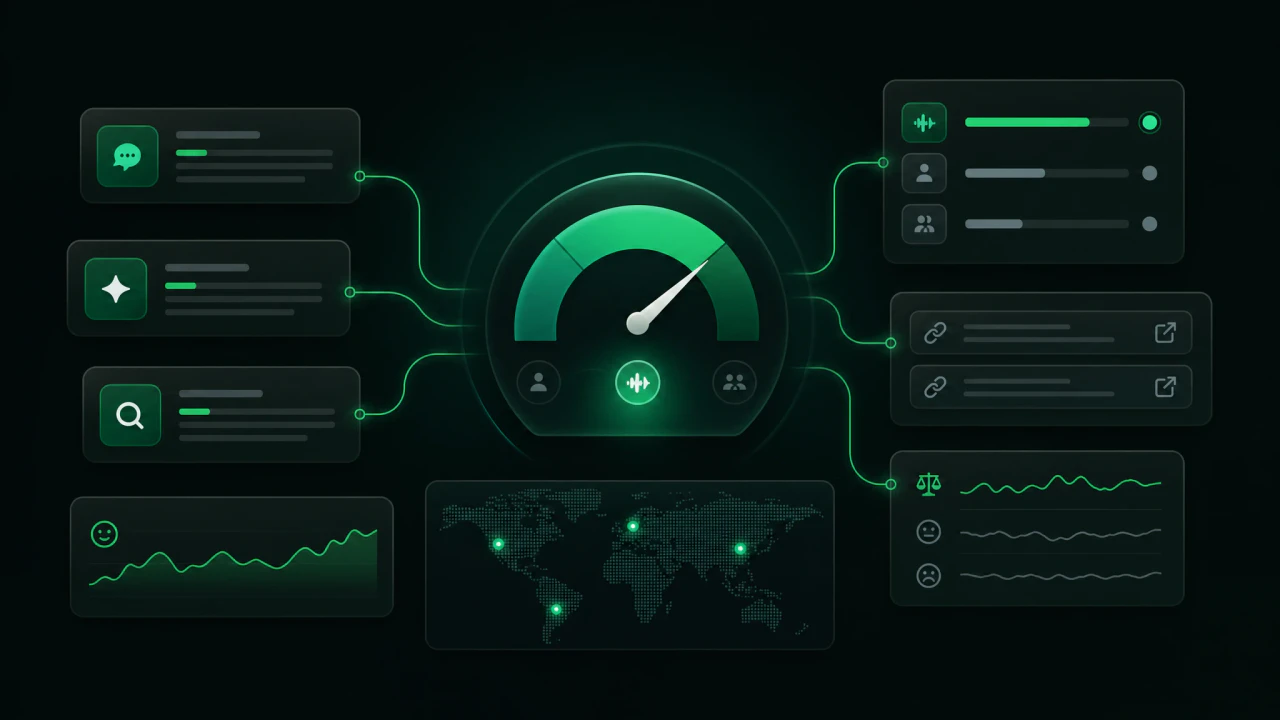
AEO marketing success means earning measurable visibility in AI answers
AEO marketing is the practice of improving how often and how accurately a brand appears in AI-generated answers, not just how well a page ranks in search results. According to HubSpot's AEO guide, Answer Engine Optimization improves visibility in AI-generated answers on systems such as ChatGPT, Gemini, and Perplexity. In practice, success means your brand is recommended, cited, described correctly, positioned against the right alternatives, and connected to business outcomes such as qualified traffic, pipeline influence, and sales conversations.
Traditional SEO data still matters. Coursera's AEO overview frames AEO and SEO as complementary because indexing, formatting, and credibility signals help AI systems retrieve and reuse content. The measurement layer is different: AEO focuses on answer presence, source citations, context, and competitive inclusion, while SEO still covers ranking, clicks, and crawl performance.
A practical model: track AI answer share of voice first, then inspect citation presence, answer position, sentiment, competitor gaps, and downstream business impact. If a visibility win cannot be tied to prompt evidence and source evidence, treat it as a signal to investigate, not a result to report.
Use answer share of voice as the primary AEO KPI
AI answer share of voice is the clearest top-level KPI because it measures whether your brand appears in relevant generated answers compared with competitors. Search rankings show where pages sit. Share of voice shows whether an answer engine includes your brand when a buyer asks for help, creates a shortlist, or compares vendors.
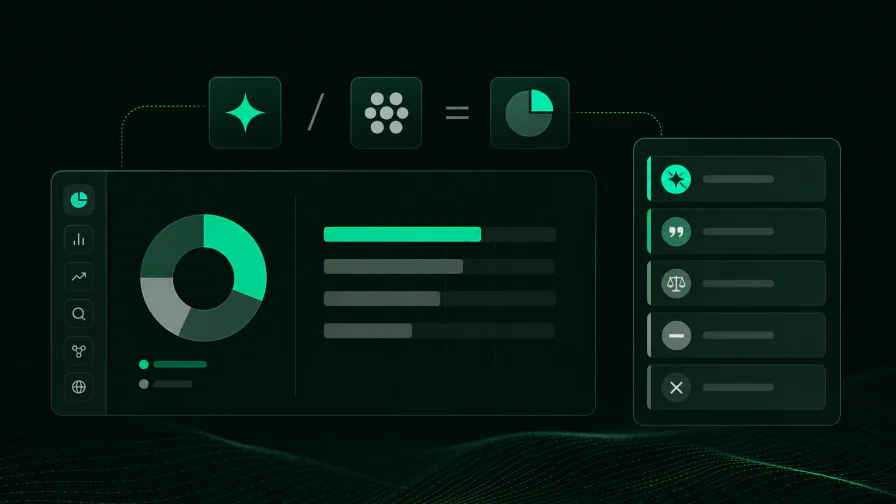
Pros and Cons
- AI answer share of voice
- Pros: It is the clearest top-level KPI for AEO because it measures whether your brand appears in relevant generated answers compared with competitors. It also shows whether an answer engine includes your brand when a buyer asks for help, creates a shortlist, or compares vendors.
- Cons: It is a visibility KPI, not a revenue substitute, so it cannot by itself show business impact. It must be paired with AI search traffic, assisted pipeline, demo requests, opportunity source data, and closed revenue.
Treat it as a visibility KPI, not a revenue substitute. A higher answer share should correlate with stronger demand capture, but it must sit beside AI search traffic, assisted pipeline, demo requests, opportunity source data, and closed revenue. The value is diagnostic: it tells marketing and product marketing where the brand is present in the decision journey and where competitors are taking the narrative.
A practical formula for AI answer share of voice
Use a controlled prompt set and calculate:
AI answer share of voice = weighted brand mentions ÷ total relevant answer opportunities
The numerator is not a flat count. Weight each mention based on its likely influence:
- Position in the answer, such as first recommendation versus later listing
- Citation status, especially when the cited source supports the claim
- Prompt intent, with buying prompts weighted higher than broad education prompts
- Context, including favorable, neutral, or unfavorable framing
- Exclusivity, such as being the only recommended vendor versus one of many
The denominator should include every prompt where a category-relevant answer could reasonably mention vendors, products, publishers, analysts, communities, or comparison sources.
What counts as a meaningful brand mention
Not every appearance has equal value. A direct recommendation for a high-intent query is materially stronger than a neutral category list. A cited mention is stronger than an uncited passing reference because it exposes the source path that shaped the answer.
Useful mention categories include:
| Mention type | AEO value |
|---|---|
| Direct recommendation | Strong positive signal when aligned with buyer intent |
| Cited brand mention | Strong evidence signal, especially when the source is credible |
| Comparison mention | Valuable if positioning is accurate and differentiated |
| Neutral category listing | Useful for awareness, weaker for decision influence |
| Unfavorable mention | Important risk signal that needs source and messaging review |
Build your prompt set from buyer intent, not vanity keywords
AEO reporting is only as useful as the prompts behind it. Build the measurement base from real buyer questions, not search-volume phrases that no one would ask an assistant. Include prompts for category research, vendor comparisons, problem diagnosis, pricing expectations, compliance requirements, integrations, implementation effort, and internal business-case support.
Good prompts sound like buying work:
- Best platforms for monitoring brand visibility in AI answers
- Compare tools for AEO and GEO reporting
- How should a SaaS marketing team measure AI search visibility?
- What evidence is needed to trust AI citation tracking?
- Which vendors help benchmark competitors in AI answers?
Prompt quality determines whether the report guides action. A weak set creates false comfort. A strong set reveals where the brand is missing from the questions that shape shortlists.

Segment prompts by funnel stage and decision role
Segment prompts by buying stage before calculating aggregate scores. Otherwise, a strong awareness presence can hide weak evaluation performance.
| Segment | Prompt intent | Roles to map |
|---|---|---|
| Awareness | Understand the problem or category | User, team lead |
| Consideration | Compare approaches and vendors | User, economic buyer |
| Evaluation | Assess proof, fit, integrations, risk | Technical evaluator, product marketing, procurement |
| Purchase | Validate pricing, terms, compliance, ROI | Economic buyer, procurement lead |
Decision-role segmentation shows where influence is being won or lost. A brand may appear often for user-led education prompts but disappear when finance, legal, or technical evaluators ask for shortlist evidence.
Benchmark competitors on the same prompts
AEO share of voice has little meaning in isolation. Measure your brand against the competitors, alternatives, publishers, analyst sources, communities, and category leaders that appear for the same prompts. The benchmark should use the same engine, market, timestamp window, and prompt wording.
Track competitive metrics such as:
- Mention rate
- Recommendation rate
- Citation frequency
- Average answer position
- Sentiment gap
- Source overlap
- Category association strength
The goal is not to chase every mention. It is to identify the prompts where competitors are being trusted more often and understand why.
Validate the measurement with evidence you can audit
Trustworthy AEO reporting needs an evidence trail. AI answers can vary by surface, model, prompt wording, freshness, location, and source retrieval. A dashboard that shows only a score without the underlying answer text is not enough for serious decision-making.
For each tracked result, keep:
- Answer engine and surface
- Model or version where available
- Exact prompt
- Full response text
- Timestamp
- Location, language, or market when relevant
- Citation URLs and cited domain categories
- Source position within the answer
- Screenshots or exports
- Sentiment and positioning labels
- Competitors and alternatives mentioned
This evidence makes visibility claims auditable. It lets teams see whether a score moved because the brand gained a top recommendation, lost a citation, appeared in a weaker context, or benefited from one volatile answer. It also supports governance: PR, legal, product marketing, and demand teams can inspect the same record instead of debating a black-box metric.

Track the supporting metrics that explain share of voice movement
AI answer share of voice tells you what changed. Supporting metrics explain why it changed and what to fix.
Track at least these secondary measures:
- Citation rate: how often answers cite sources connected to your brand or category
- Source coverage: which owned, earned, community, reference, and competitor domains shape answers
- Answer position: whether the brand appears first, mid-answer, or near the end
- Co-mentions: which competitors, partners, integrations, or category terms appear with the brand
- Sentiment: whether the brand is framed positively, neutrally, or unfavorably
- Category association: whether the answer connects the brand to the correct market and use case
- Content gap frequency: how often missing or weak content maps to lost visibility
These metrics turn measurement into a work queue. A falling citation rate points to source issues. Weak category association points to entity clarity and content structure. A negative sentiment gap points to proof, positioning, or third-party coverage that needs attention.
Turn AEO data into content, PR, and product marketing actions
AEO measurement should produce specific shipping decisions. If buyers ask comparison prompts and the brand is absent, create or improve answer-ready comparison content. If AI answers cite outdated third-party pages, refresh owned documentation and pursue corrections or new earned coverage. If pricing, compliance, or implementation prompts produce vague answers, publish precise pages that reduce ambiguity.
Prioritize actions by prompt value and evidence quality:
- Build concise pages that answer the target question in the first paragraph
- Add structured FAQs, comparison tables, schema, and clear entity references where useful
- Strengthen documentation for integrations, security, implementation, and use cases
- Update product marketing narratives where competitor positioning is winning
- Close third-party coverage gaps with analyst, partner, customer, and community proof
- Feed findings into AI content workflow so new content is grounded in measured demand
The best action is small enough to ship quickly and specific enough to remeasure.
Where Mentionpath fits in the AEO measurement workflow
Mentionpath is a SaaS platform that measures and improves how brands appear in AI answers and search. It tracks AI answer visibility, citations, sources, sentiment, positioning, and competitor performance so marketing teams can see where the brand is present, absent, recommended, or misrepresented.
The platform is built for teams treating AEO and GEO as operating disciplines, not one-off experiments. Use AI search visibility to monitor prompt-level presence, mentions and sources to inspect citation paths, and competitor benchmarking to compare share of voice across the same questions. Mentionpath also surfaces content gaps, which helps teams decide what to write, update, or strengthen next.
Generic performance reporting often misses answer-engine-specific signals such as structured data fit, entity clarity, and citation context. That is why AEO measurement needs prompt evidence, source evidence, and competitive context in one workflow.
Make AEO measurement a weekly operating habit
Make AEO measurement a weekly operating habit because answer visibility changes as models update, sources change, competitors publish, and buyers ask different questions. A static audit goes stale quickly. A repeatable cadence turns measurement into market memory, and daily tracking helps you spot trends before they become obvious in the weekly review.
Use a simple weekly cycle:
- Refresh the prompt set with new buyer questions, sales objections, competitive threats, and product changes.
- Rerun share of voice tracking across the same controlled prompt groups.
- Inspect evidence for large gains, losses, unfavorable mentions, and citation changes.
- Prioritize fixes by commercial value, confidence, and effort.
- Ship content, documentation, PR, and positioning improvements.
- Remeasure the affected prompts and record what changed.

The teams that win in answer engines will not be the ones with the largest report. They will be the ones that connect prompt evidence to shipped improvements, then repeat the cycle before the market narrative hardens without them.